
Why documentation is the standard for WA commercial cleaning compliance — learn how cleaning records protect operations and build lasting vendor trust in Washington State.
Facilities Management, Commercial Cleaning Standards, Washington State
In Washington State’s tightly regulated commercial environment, “it looks clean” is no longer a defensible benchmark. Facility managers, property managers, and building owners are increasingly expected to demonstrate not just that cleaning occurred, but that it met defined, verifiable standards. Documented commercial cleaning, supported by corrective-action reporting, is now a core element of risk management, regulatory compliance, and tenant confidence.
Cleaning That Goes Beyond What You Can See
Documented processes that protect Washington State facilities, tenants, and owners
Why Visual-Only Cleaning Verification Fails
Relying on visual inspection alone is inherently subjective. A corridor can appear spotless while high-touch points such as door hardware, elevator buttons, and shared work surfaces still harbor pathogens or residues. Dust and debris are easy to spot; microbial contamination is not. For Washington State facilities that host hundreds or thousands of occupants daily, this gap between appearance and actual cleanliness creates a silent vulnerability.
Visual checks also vary from person to person. One supervisor may accept streaked glass or partially cleaned restrooms; another may not. Without defined commercial cleaning standards and objective verification methods, there is no consistent baseline. This inconsistency undermines cleaning accountability and makes it difficult to compare performance across shifts, vendors, or locations within your portfolio from Seattle to Spokane or Vancouver to Bellingham.
Furthermore, visual-only approaches rarely capture process details. You cannot see whether the correct dwell time was observed for a disinfectant, whether fresh microfiber was used on each room, or whether a restroom was serviced according to its traffic level. These process elements are where risk often hides, and they can only be confirmed through structured facility cleaning documentation, not a quick walk-through at the end of a shift.
The Hidden Risks of No Cleaning Documentation
The absence of written records may feel convenient in the short term, but it introduces significant exposure for facility operators. When an incident occurs—such as a tenant complaint, an indoor air quality concern, or an infection cluster—one of the first questions asked is, “Can you show us how and when this space was cleaned?” Without facility cleaning documentation, the answer is often an uncomfortable “no,” leaving you reliant on memory and verbal assurances rather than evidence.
In Washington State, many sectors operate under heightened scrutiny: healthcare-adjacent offices, food production and distribution facilities, schools, and public-facing government buildings. Even traditional office properties are being evaluated more closely by tenants who now ask detailed questions about cleaning protocols in lease negotiations and RFPs. When you cannot provide documented commercial cleaning records, you may lose competitive ground to facilities that can demonstrate robust, auditable processes.
The legal and financial implications are also substantial. In a dispute or claim, the lack of documentation can be interpreted as a lack of due diligence. Insurers, regulators, and legal counsel typically look for written logs, schedules, and incident reports to determine whether reasonable steps were taken to protect occupants. Without them, you may find it harder to defend your position, negotiate settlements, or demonstrate compliance with applicable commercial cleaning standards and local health guidance.
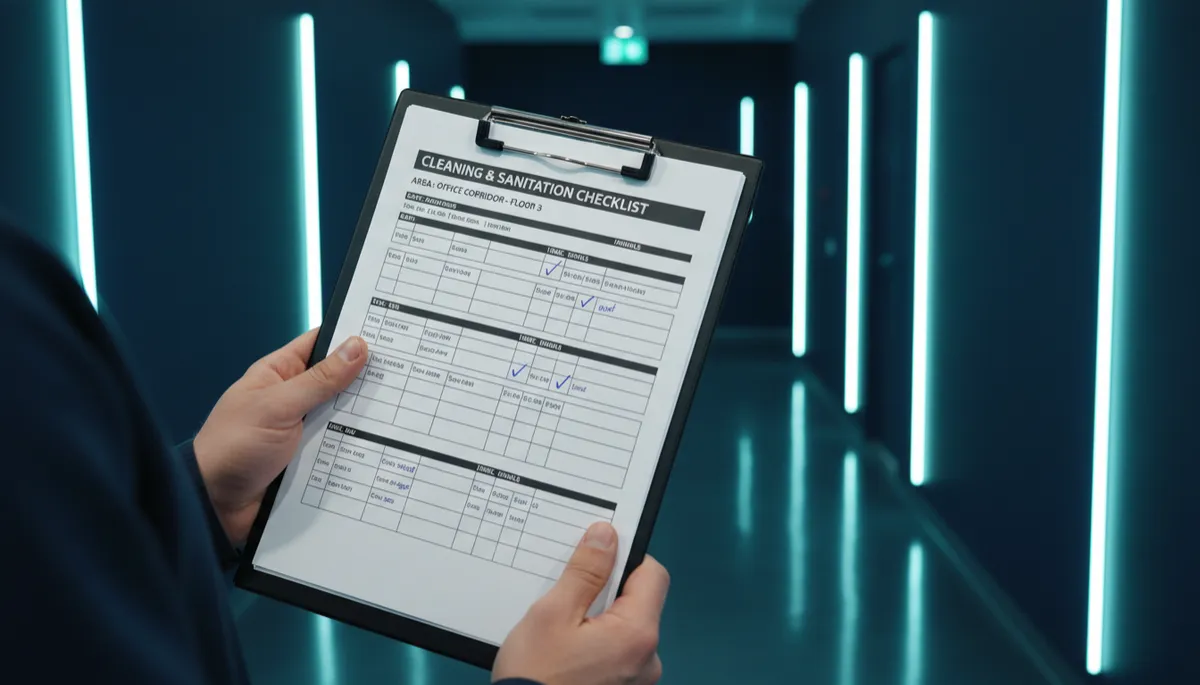
Time-stamped cleaning logs create a defensible record of due diligence and care.
What Effective Facility Cleaning Documentation Includes
Effective documentation is more than a sign-off sheet on the back of a restroom door. For meaningful cleaning accountability, Washington State facilities benefit from a structured documentation framework that captures who performed the work, what was done, when it occurred, and according to which standard or specification. This can be managed digitally or on paper, but the underlying elements should be consistent and repeatable.
- Scope and frequency: Documented task lists by area (e.g., restrooms, lobbies, elevators, production zones) and defined frequencies (daily, weekly, monthly, periodic).
- Methods and products: Approved procedures, dwell times, dilution ratios, and equipment used, aligned with manufacturer instructions and relevant regulations.
- Verification records: Checklists, inspection scores, and notes from supervisors or third-party quality audits supporting consistent cleaning verification Washington State stakeholders can trust.
When this information is centralized, facility managers gain real-time visibility into performance trends, recurring problem areas, and compliance gaps. Instead of reacting to complaints, you can proactively adjust staffing, retrain teams, or revise scopes of work based on documented evidence rather than assumptions.
How Corrective-Action Reporting Protects Facility Operators
Documentation is powerful, but its real value emerges when paired with a formal corrective-action process. Corrective-action reporting records what happens when cleaning falls short of established commercial cleaning standards and, crucially, what is done to resolve the issue and prevent recurrence. For Washington State facility operators, this creates a defensible narrative of continuous improvement and responsible management.
A typical corrective-action report might include the date and time of the issue, the area affected, the nature of the deficiency (for example, missed disinfection of high-touch points in a conference center), the root cause analysis, and the specific steps taken to correct and monitor the situation. When tied to your broader facility cleaning documentation, these records demonstrate that you did not ignore problems—you investigated and addressed them systematically.
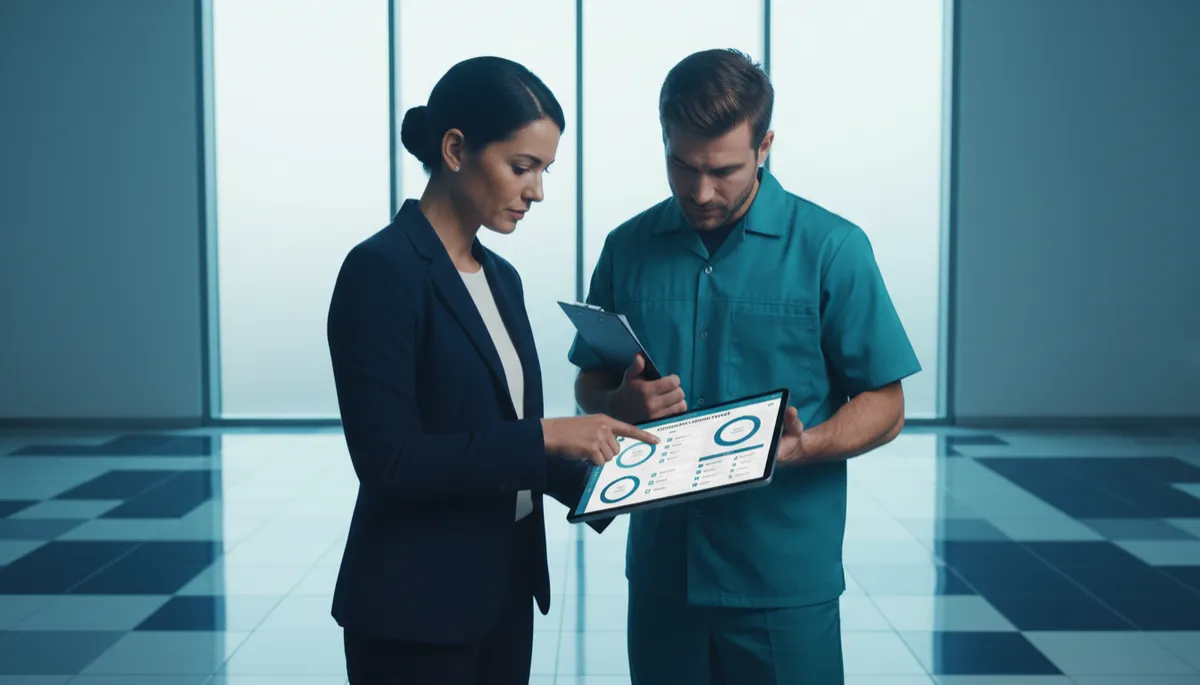
Digital corrective-action workflows turn one-time issues into long-term process improvements.
From a risk perspective, this is critical. In the event of a complaint, inspection, or claim, being able to show a chain of documented commercial cleaning activities, inspections, and corrective actions can significantly reduce liability. It signals to regulators, insurers, and tenants that your operation is governed by process, not by chance. For multi-tenant office towers, industrial parks, and mixed-use developments across Washington, this level of transparency can strengthen relationships and support higher occupancy and retention.
Turning Documentation into a Strategic Advantage in Washington State
While documentation and corrective-action workflows are often viewed as compliance tasks, they also create a strategic advantage. When your facility can present clear, organized records of cleaning verification Washington State tenants and stakeholders gain confidence. Prospective occupants evaluating space in Tacoma, Bellevue, or Olympia increasingly ask for specifics about cleaning programs; being able to provide detailed reports differentiates your property in a competitive market.
Internally, documented processes also make it easier to transition between vendors or onboard new staff. Instead of relying on tribal knowledge, you can hand over defined commercial cleaning standards, task lists, and reporting expectations. This reduces disruption, shortens ramp-up time, and keeps service levels stable even as teams change. Over time, your data set can inform budgeting, staffing models, and capital planning related to finishes, flooring, and building systems impacted by cleaning practices.
Moving Beyond “Looks Clean”
For Washington State facility managers, property managers, and building owners, the path forward is clear. Visual inspection still has a place, but it must be supported by documented commercial cleaning programs, consistent facility cleaning documentation, and a robust corrective-action framework. Together, these elements transform cleaning from a cosmetic activity into a measurable, defensible component of your overall risk and operations strategy.
“Looks clean” is an impression. Documentation is proof. In an environment where health expectations, regulatory demands, and tenant scrutiny continue to rise, proof is what protects your facility, your occupants, and your organization’s reputation.